
Christ Is Risen, Alleluia!
Truly He Is Risen, Alleluia!

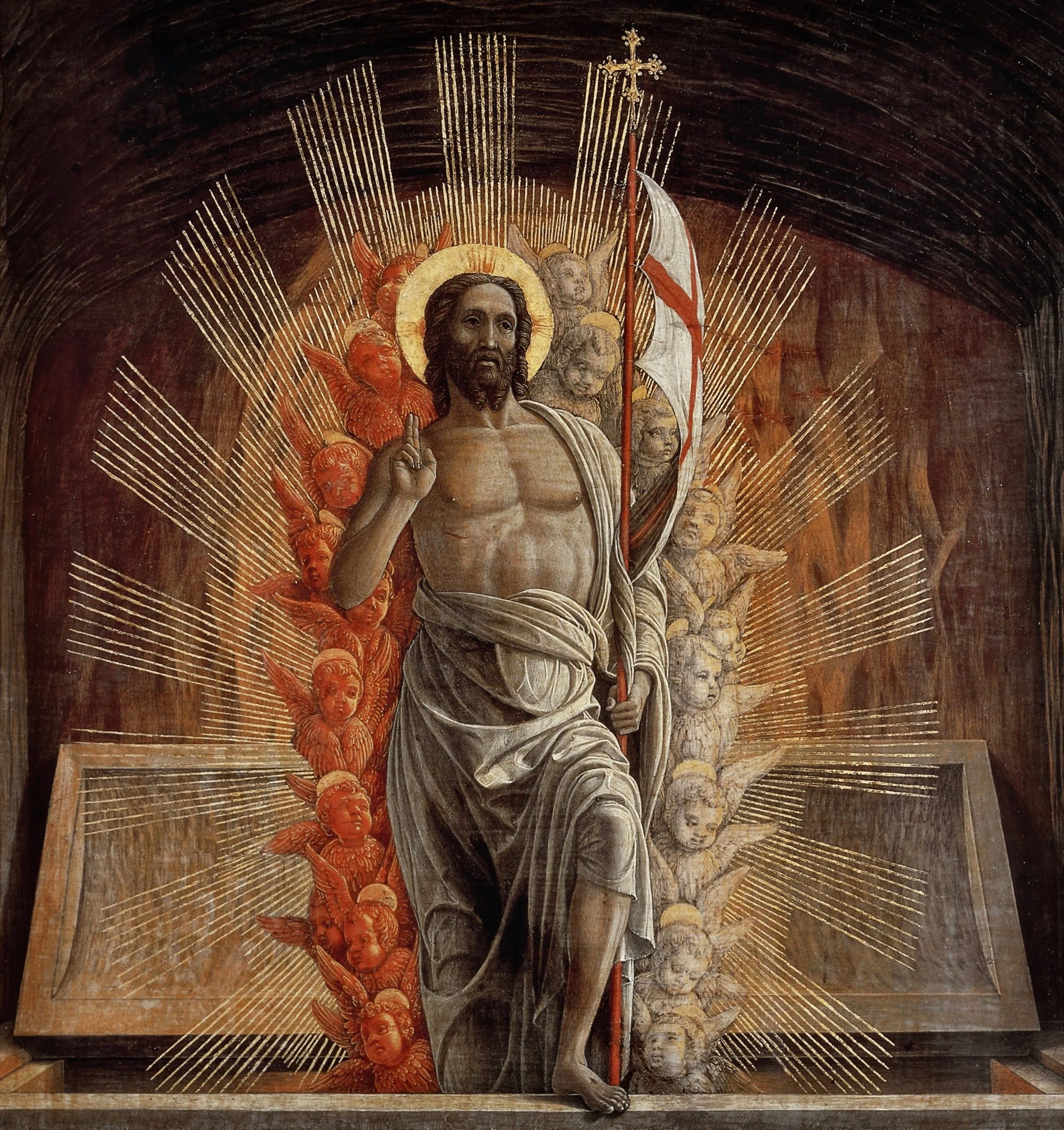
God be praised, friends; it is the Passover of the Lord!
The Gospel today tells us about the early morning of the Day of Resurrection when John and Peter raced to the tomb of Jesus Christ to see for themselves what Mary Magdalene had reported: the tomb is empty! John was younger and faster and reached the sepulchre first, but out of deference for Simon Peter, John paused and waited. When both men beheld the empty tomb, they were puzzled. They did not yet understand the glory to be revealed in the Risen Lord.
Meanwhile, the first lesson today tells us about an event nine years after that morning in Jerusalem, and Simon was no longer confused. Saint Luke tells us in the Acts of the Apostles about the day when Simon Peter went to the home of a Roman centurion named Cornelius who lived in the city of Caesarea, a port on the Mediterranean coast just south of the modern city of Haifa.
The ancient Phoenicians had a settlement at the site of Caesarea, but it was Herod the Great who built the new city and harbor which became the capital of the Roman province of Judea just a few years before the birth of the Lord Jesus. It was Herod who named Caesarea after his patron, the Roman Emperor Caesar Augustus, and it was also Herod who murdered all the little boys in Bethlehem in his vain attempt to kill the Christ.
Chapter ten of the Acts of the Apostles describes how the Centurion Cornelius and the Apostle Peter were each directed by angels to come together for an encounter which was an inflection point in the Church’s mission to preach the Gospel of Jesus Christ to all nations as Christ commanded in the Great Commission given at his Ascension.
Luke tells us that Cornelius was an honest and honorable officer in the Roman army who sought to live an upright life by worshiping God as he understood him and by treating all other people with charity and justice, including especially the Jews who lived under Rome’s authority.
Saint Luke describes the Gentile Cornelius as devout and God-fearing and says that he prayed to God constantly. In this way, Cornelius is a classic example of a pagan who does not yet know the truth of divine revelation but whose life is nonetheless imbued with a deep religious sense or what the Second Vatican Council called an “awareness of a hidden power, which lies behind the course of nature and the events of human life.” (Nostra Aetate, 2).
It was to pagans such as Cornelius that the Apostles first proclaimed among Gentiles the Good News of salvation in Jesus Christ. The Church bore witness to the truth that the Son of Mary is also God the Son, that he was tortured, murdered, and buried just as he said he would be, and that early on a Sunday morning, the Risen Lord Jesus threw down the gates of death and walked out of his tomb to reveal the superabundance of God’s grace and glory in the Resurrection to eternal life.
And that is what Simon Peter explained to Cornelius and his family and friends at Caesarea nine years after that morning at the empty tomb in Jerusalem: that Jesus of Nazareth, who was baptized by John, was anointed by God the Father as the Christ and was filled with the Holy Spirit and power. The Lord Jesus then traveled the land healing the sick and proclaiming the Good News of salvation, but the Temple authorities put him to death by hanging him on a tree.
“This man,” Peter continued “God raised up on the third day and granted that he be visible not to all people but to us, the witnesses chosen by God in advance, who ate and drank with him after he rose from the dead. He commissioned us to preach to the people and testify that he is the one appointed by God as judge of the living and the dead.” Peter concluded, “To him all the prophets bear witness, that everyone who believes in him will receive forgiveness of sins through his name.”
And friends, the primary difference between the Apostles and us is simply time, the two thousand years that lie between their time and ours. For we are here today precisely because like the Apostles we are witnesses to Christ’s Resurrection. In Holy Baptism we were chosen by God, called by name and then sent to testify that Jesus of Nazareth is the Son of the living God, the divine Messiah who offers forgiveness of sins to all who trust in him.
Only the Risen Lord Jesus can give us the freedom of the children of God by a share in his own divine nature. This a supernatural gift that we receive from him by grace through faith when we eat and drink with Christ as the Apostles did and as we are about to do in the sacrificial meal of the Most Holy Eucharist.
When Cornelius and his household heard the Gospel proclaimed by Peter, they received the Word of God with the obedience of faith and were filled with the Holy Spirit, and then all who accepted Jesus Christ as Lord and Savior were baptized and so were made children of God by the grace of adoption and heirs of the Kingdom of Heaven.
Two thousand years later, we are gathered here to celebrate the Resurrection of Jesus Christ by renewing the promises of our Baptism and then we will be nourished unto everlasting life by his sacred Body and precious Blood. And thus we are prepared by divine grace and sent to teach the whole counsel of God to everyone we meet.
But to be witnesses of Christ requires us not just to come to Mass on Sunday, and still less only on Easter Sunday. No, to be witnesses of Christ also requires us to make a decision for Christ and to live the life of grace every day by constant conversion through the virtues of faith, hope, and love. Only then are we able to proclaim the Gospel to everyone we meet by introducing them to saving friendship with the Lord Jesus, just as Peter did with Cornelius.
So, let’s make this general principle specific and concrete: have you ever spoken to someone else about your faith in the Risen Lord Jesus? By which I mean have you spoken of Christ by name - that is, spoken aloud the holy name of Jesus, the only name under heaven given among men by which we are to be saved?
Think about the first time you found yourself powerfully drawn to another person and longing to say: I love you. In contemplation of that first utterance, you were filled with terror and anticipation. Speaking of Jesus Christ by name to another person for the first time can be very much like that.
But once you start telling people about your friendship with Christ, just as after you have grown accustomed to saying to your beloved “I love you,” then you can’t stop. When we speak about his divine grace and the power of his mercy, we find that we cannot stop, because the Lord Jesus is the Alpha and the Omega, the First and the Last, the Beginning and the End. And speaking to others of the Savior by his holy Name is what we must do if we are to lead others to saving faith in Jesus Christ.
You see, it is not enough to speak vaguely of the unnamed God or of God’s universal love or to promise our prayers for those who have not yet received the Gospel. No, we must explain that Jesus Christ is Lord, not only of this cosmos but of my life, and then we must try to help the one to whom we bear witness understand what it means to say “Jesus Christ is Lord” and why this truth alone will lead them fully to know, love, and serve the living God, which is what we must all do if we are to understand why we exist.
Explaining the Gospel requires that we teach everyone to reverence the Holy Scriptures of the Old and New Testaments as the inspired and infallible Word of God, but to do that we must first know the Scriptures ourselves. Then we must invite them to worship the living God in spirit and truth by coming to the altar, and that means inviting them to come where we already go - to Mass every Sunday in celebration of the Resurrection of Jesus Christ.
The entire world is the Church’s mission field, and for us the mission starts just outside our doors. Every home and office, every business and neighborhood, every school, university and social club is filled with people who need to hear the Word of God in order to receive Jesus Christ with saving faith, and we are their missionaries.
By our Baptism, we are sent to them all so that they will hear the Gospel, rejoice in the Resurrection, and accept Jesus Christ as Lord and Savior by a decision to follow him in the Way of the Cross, to seek the forgiveness of sins in his holy Name, and to live the life of grace in Christ’s holy Church. That, friends, is our commission. And we are strengthened for this work by the Savior who calls us by name and sends us as his witnesses.
Last night in the great Vigil of Easter, the Church announced that all time belongs to Christ and all the ages of this world. To the Risen Lord Jesus be glory and power through every age and for ever, because the saving truth of the world’s redemption is this:
Christos Anesti! Alithos Anesti!
Christ is Risen! Truly He is Risen! Alleluia! Alleluia!
This is the text of my homily for 5 April 2026, Easter Sunday.
Fr Jay Scott Newman