
Man Does Not Live On Bread Alone
But On Every Word from the Mouth of God

Lex orandi, lex credendi. The law of prayer is the law of belief, meaning that how we pray reveals what we believe. This adage teaches us that the proclamation and explanation of the Gospel occurs primarily in divine worship rather than in a library or a lecture hall, and one of the richest treasures of our prayer and belief in the sacred liturgy is a group of texts called the prefaces to the Eucharistic Prayer.
At every Mass the priest says or sings one of the prefaces just before the congregation joins with the angels and saints in singing the praises of the Thrice Holy God. And our preface today, speaking of the Lord Jesus, says that “by abstaining forty long days from earthly food, he consecrated through his fast the pattern or our Lenten observance. And by overturning all the snares of the ancient serpent, (Christ) taught us to cast out the leaven of malice, so that celebrating worthily the Paschal Mystery, we might pass over at last to the eternal paschal feast.”
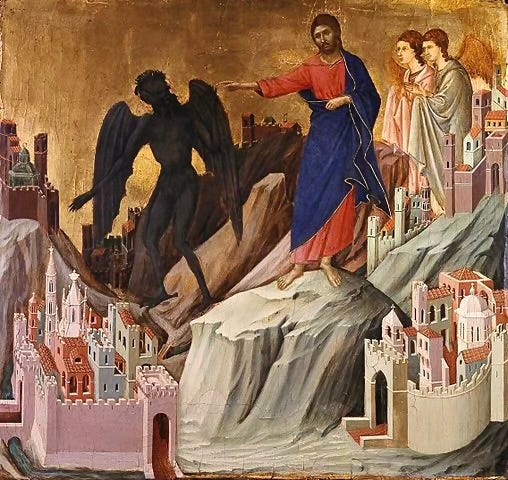
So as we begin the Forty Days of our Lenten observance, let’s look briefly at each part of this prayer. In the Gospel today we read that Christ spent forty days in the wilderness between his Baptism in the Jordan and the beginning of his public ministry. In so doing, the Lord Jesus followed the example of Moses and Elijah, both of whom would join him at his Transfiguration three years later to prepare him for his passion and death, an event said by ancient tradition to have been forty days before Good Friday.
The preface goes on to say that Christ overturned all the snares of the ancient serpent, and this is a reference both to his own temptations and to the account in Genesis of Satan’s seduction of our first parents about which we read in today’s first lesson. In the Garden, our Enemy lied to Adam and Eve, telling them that if they disobeyed God and chose their own path rather than their Creator’s, they too would become like gods. But in their disobedience they did not find divine glory and perfect freedom.
Instead, they found slavery, suffering, and death, and they exchanged the original and beautiful order in which they were created for disordered relationships with the earth, with each other, with their own bodies, and with God. But as we read in the second lesson today from Saint Paul’s Letter to the Romans, this calamity caused by the disobedience of Adam and Eve was reversed by the perfect obedience of Jesus Christ, from whom we receive the gift of justification by grace though faith.
But how did Christ overturn all the snares of the ancient serpent? In the Gospel today, we read that in his battle with the Enemy, who is a liar and a murderer, the Lord Jesus relied on Holy Scripture to refute the tempter and resist the seductions of this fallen world: lust of the flesh, lust of the eyes, and pride of life.
And this point is crucial for us. The Lord Jesus is the Eternal Word made flesh, but even he relied on the Word of God written in Holy Scripture to turn away the devil, and this means that the more deeply we know the Sacred Scriptures from our own prayer and study, the better prepared we will be to resist temptations when they come.
Please note, however, that the Enemy also quoted Scripture in his dispute with the Incarnate Word, and Satan’s ploy is the first recorded example of proof texting, which takes one verse from the Bible out of the context of the whole in an effort to make Scripture seem to say what it does not mean.
So, only in reading each verse of the Bible in the context of all the other texts of Scripture and in the light of the Apostolic Tradition can we come to understand the meaning of the whole, and that is precisely what Christ does.
This is among the many reasons why we need to read Holy Scripture only in keeping with the mind of the Church, so that we can understand the Gospel as a coherent whole by means of the analogy of faith which shows us how every truth revealed by God fits together seamlessly with all other truths. If we fail to read the Bible in this way, then we will not know the whole counsel of God and we can be led astray even by Holy Scripture because of the Enemy’s way of misusing holy things to his advantage and our confusion.
Now back to the preface. Having explained that Christ overturned the snares of the ancient serpent, the preface then mentions something called the leaven of malice, and here we must turn to Saint Paul’s First Letter to the Corinthians.
Paul wrote to the Christians in Corinth to challenge immoral behavior, to correct liturgical abuses, and to teach them how to hold fast to the Gospel that he had preached among them. And one of the most powerful images in Paul’s letter is his explanation of Christ’s atoning death by reference to the slain lamb and the Seder Supper which begins the annual Jewish celebration of Passover.
Recall that Moses was sent by God to convince Pharaoh to release his chosen people from slavery, but nothing short of the passover of the angel of death was sufficient to secure their deliverance.
According to God’s instruction, a lamb was slaughtered to feed each family for the journey, and its blood marked the homes of the Hebrews to save them from death. Then when Pharaoh finally relented, the Israelites left Egypt in such haste that their fresh bread did not have time to rise before baking.
That is why during the seven days of the Feast of Unleavened Bread which immediately follow the Passover Seder, no leavened bread may be present in Jewish homes. From this ritual use of unleavened bread comes the idea that leaven or yeast stands for moral corruption and spiritual slavery, and that is why the Western Church celebrates the Holy Eucharist with unleavened bread.
And so Saint Paul wrote to the Corinthians in words we will hear on Easter Sunday: “Cleanse out the old leaven that you may be new dough … For Christ, our Paschal Lamb, has been sacrificed. Let us, therefore, celebrate the festival not with the old leaven, the leaven of malice and evil, but the with the unleavened bread of sincerity and truth.” (1 Corinthians 5.7-8)
And now we have a new word to sort out: paschal. In most languages, the word for Resurrection Sunday is some form of the Greek word pascha, which itself is a rendering of the Hebrew word pesach, meaning Passover. But in English we call that day Easter from an old German word which likely refers to the geographical East, the place in which the sun rises.
So, the words Pascha, Passover, and Easter all speak of the same reality: namely, the sacrificial death and glorious Resurrection of the true Lamb of God whose blood is deliverance from death and whose flesh is food for the journey to freedom.
The Lord Jesus Christ is the Paschal or Passover Lamb, and in order to participate worthily in the celebration of his passion, death, and Resurrection we must cleanse out of our lives the old leaven of malice and evil and live by the unleavened bread of sincerity and truth, meaning the Holy Eucharist in which the Paschal Lamb both cleanses us of sin and feeds us with his Body and Blood.
Every Sunday of the year is a little Easter, a celebration of the Resurrection of Jesus Christ, but during these Forty Days of fasting, prayer, and almsgiving, we prepare to celebrate worthily the solemn annual commemoration of the Day of Resurrection.
And so on Passover or Easter Sunday we will all renew the promises of our Baptism before sharing in the feast of the Holy Eucharist, the Passover Sacrament or Paschal Mystery which is a foretaste of the eternal Wedding Feast of the Lamb.
And now we come back to the preface. Lex orandi, lex credendi. The law of prayer is the law of belief. This ancient principle is completed by a third law: lex vivendi or the law of living. Lex orandi, lex credendi, lex vivendi. As we pray so we believe, and as we believe so must we live.
And when we fail to live as we pray and believe, then the Lord Jesus offers us his mercy in the gift he gave to his Church on Easter Sunday: the sacrament of penance, in which he restores our baptismal innocence and prepares us once again to celebrate worthily the sacred mysteries, especially the Lord’s Supper.
And that is why going to Confession during Lent is the very best way to renew the grace of our Baptism and to cast out the leaven of malice in preparation for the Passover of Christ.
Friends, our Lenten observance is not about self-improvement, and it is not an effort to justify ourselves or to earn God’s love; those things are impossible. Lent, rather, is our response to God’s love already perfectly revealed in the sacrificial life, atoning death, and glorious Resurrection of the true Passover Lamb.
During these Forty Days of fasting, prayer, and almsgiving, we are called to live the grace of our Baptism ever more intentionally and to forsake everything that is not of God and so live in the freedom of the children of God.
Let us then cast out the leaven of malice and worthily celebrate the Paschal Mystery, so that by the grace of the Resurrection we may pass over at last to the eternal wedding feast of the true Lamb of God, the Lord Jesus Christ.
This is the text of my homily for 22 February 2026, the First Sunday of Lent.
Fr Jay Scott Newman